
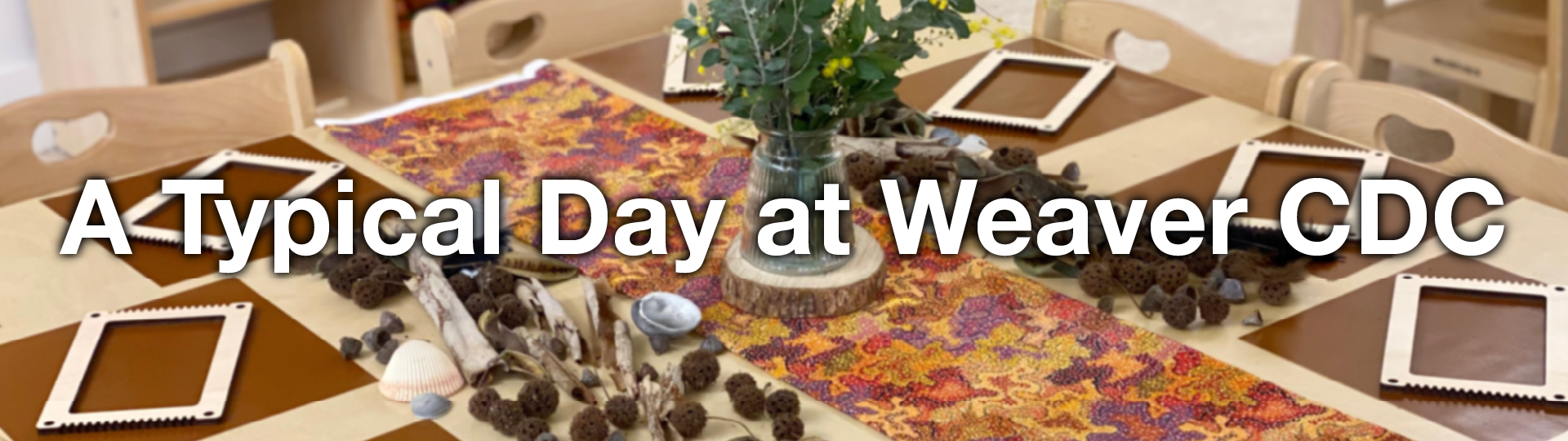
For families considering a new school, one big question is “What does a typical school day actually look like?” At Weaver Child Development Center (CDC), the answer is a little different. While students follow a predictable school routine, no “typical” day looks the same across classroom or age groups.
That is because Weaver CDC balances structure with flexibility. Students know what to expect throughout their day, while teachers have the freedom to respond to children’s interests and needs. This approach reflects Weaver CDC’s commitment to whole child education. Here, academic learning connects to social, emotional, physical, and creative development.
A School Routine that Honore Engagement and Time
When children are deeply involved in building, storytelling, problem-solving, or a creative provocation, Weaver CDC stays with it. These are the moments when learning becomes meaningful. When children test ideas, collaborate, persevere, and make connections.
In Reggio-inspired schools, time is not something to race through, it is something to respect. Weaver CDC gives children time to linger, return to ideas, revisit materials, and stay with work longer. This helps deeper thinking unfold.
At Weaver CDC, time is a partner in learning. The school schedule reflects this philosophy. Children have familiar routines and expectations. But the day does not plan student transitions between activities just because of the clock.
What Does the Average School Schedule Look Like?
The children’s daily schedule is flexible when needed. It also provides enough structure to give students predictability. A Reggio Emilia classroom is a safe and comforting place and why it is important that kids know what to expect and when to expect it.
Here are sample schedules for each age group. These schedules give families a clear view of the day’s general flow. They also leave room for the flexibility that matters at Weaver CDC.
Preschool
- 9:00-9:15 – Independent Exploration
- 9:15-9:30 – Opening Group Time
- 9:30-10:30 – Independent Exploration
- 10:30-10:45 – Clean-up and Snack
- 10:45-11:15 – Large Muscle Activities
- 11:15-11:30 – Closing Group Time/Preparation for Dismissal
Kindergarten
- 8:45 – 9:15 – Arrival – greeting time – table activities/journal writing
- 9:15 – 9:45 – Morning Meeting – sharing, calendar, concepts, music, etc.
- 9:45 – 11:00 – “Jobs” – learning centers
- 11:00 – 11:25 – Literacy – books, stories, music, surprise bag, etc.
- 11:30 – Dismissal
Kindergarten Afternoon Enrichment Program
- 11:30-11:45 – “Still Time” & Prepare for Lunch
- 11:45 – 12:45 – Lunch/Recess
- 12:45 – 2:30 – Afternoon Enrichment
- 2:30 – Dismissal
1st – 6th Grades
- 8:45 – Arrival – greeting time
- 9:15 – Morning Meeting
- 9:15 – 11:45 – Reading, Language Arts and Math Block
- 11:45 – 12:45 – Lunch/Recess
- 12:45 – 2:30 – Social Studies, Science, Enrichment Block
- 2:30 – Dismissal
These schedules provide an outline for the day, but don’t tell the entire story of what happens inside a Weaver CDC classroom.
Emergent Curriculum and Child Led Learning
The curriculum at Weaver CDC is emergent. This means that teachers plan with intention but also openness. The curriculum is not something delivered to children, but something that grows from them.
A planned lesson may:
- Deepen into a shared project,
- Shift direction based on children’s questions,
- Expand into research or design work,
- Or evolve into something entirely new.
This doesn’t take the class off track academically. It draws students deeper into literacy, math, science, and social learning because children stay invested and curious.
This is also where the whole child education mission becomes visible in the classroom. Teachers are intentional about what they introduce and how they support learning. They also stay open to the directions children take their discoveries.
Outdoor Play is Part of the School Routine
Outdoor time is essential at Weaver CDC. It’s not just a break, but a vital part of how children learn, regulate, and connect.
Every class has scheduled morning and afternoon outdoor play. Teachers also pay close attention to the energy of the group. If they sense they need movement, fresh air, or simply a reset, everyone goes outside again.
Large-muscle play varies developmentally:
- Preschoolers have outdoor times and gross-motor opportunities built right into their day.
- Kindergarten through 6th grade enjoy two ‘scheduled’ daily recesses, plus flexible outdoor time as needed.
Children build forts, explore nature, engage in imaginative play, test physical skills, and collaborate in ways that simply can’t happen indoors. Movement isn’t an “extra”, it’s foundational.
Outdoor play is one part of whole child education at Weaver CDC. Children need opportunities to move, explore, connect, and engage with their environment. The same way they need opportunities to develop academically.
Enrichment and Afternoon Exploration
The afternoon looks different depending on the age of the student. Kindergarten students in the Afternoon Enrichment Program continue their day from 11:30 to 2:30. Students in 1st through 6th grades have social studies, science, and enrichment during their afternoon block.
Enrichment is part of the broader school schedule. It gives students time to experience different subjects and forms of learning throughout their day. Enrichment time can include music, art, large motor play, and more.
At Weaver CDC, enrichment fits into our larger philosophy and is not simply about filling time. It creates a learning environment where children can explore, create, collaborate, and make connections across disciplines.
Reggio Emilia Woven Throughout the Day
Ultimately, there is no typical school day at Weaver CDC because the Reggio-inspired approach shapes the whole experience. Time here is not something to race through, but something to respect.
That philosophy influences how teachers plan, how classrooms respond to children’s questions, and how students find opportunities to revisit ideas and deepen their understanding. Time is a partner in learning.
This is what makes a Reggio Emilia classroom different. Every activity isn’t predetermined and where every transition happens according to the clock.
There is structure, but there is also room for curiosity. There are learning goals, but there is room for exploration. There is a school routine, but there isn’t a rigid path that every child must follow at exactly the same pace.
See a Typical School Day for Yourself!
A school schedule can give families an idea of what to expect, but the best way to understand the Weaver Way is to see it in person. From morning meetings, outdoor play, provocations, enrichment, and explorations, each part of the day contributes to a learning environment centered on the whole child.
The goal is not to move children from one activity to the next. It is to give them time to wonder, discover, create, connect, and grow.
If you would like to experience a Reggio Emilia classroom in action, schedule a tour of Weaver CDC today.