

At Weaver Child Development Center (Weaver CDC), learning is rooted in curiosity, discovery, and growth. As a Reggio-inspired school, we believe that children thrive when learning reflects these values.
Grading should be clear, supportive, and reflective of students’ learning path. This is why Weaver CDC uses standards-based grading. This grading system highlights progress, celebrates mastery, and gives meaningful insights into what children are learning.
Rather than relying on broad letter grades, this alternative grading approach aligns naturally with our Reggio philosophy. By focusing on knowledge, skills, and understanding, this method helps children achieve mastery over any subject.
What is Standards-Based Grading?
Standards-based grading (SBG) is a way to assess how well students are mastering specific goals. These goals are called “learning targets”. This grading system does not average points or percentages. Instead, it focuses on what students can do and show over time.
Children engage in projects, discussions, hands-on tasks, and everyday classroom learning while at Weaver CDC. Teachers assess their progress toward each “learning target” and provide real-time feedback to support improvement and deeper learning.
This allows students to grow at their own pace and ensures every child has opportunities to achieve mastery.
This method is an alternative grading practice because it moves away from traditional point-based scoring. Instead, it centers on clarity, transparency, and holistic growth.
Why Alternative Grading Fits Weaver CDC
Weaver CDC’s identity as a Reggio-inspired school makes standards-based grading a natural fit. In the classrooms:
- Children are partners in their own learning
- Teachers observe, document, and respond to each child’s needs
- Exploration, creativity, and collaboration guide daily experiences
- Families are encouraged to participate in learning
A traditional letter grade cannot capture the richness of this process. But a thoughtful grading system that highlights specific skills and learning targets can.
By using an alternative grading approach, teachers can document a child’s growth. Students show understanding through stories, conversations, projects, artwork, hands-on investigations, and other work. This aligns with a core belief of the Reggio Emilia approach!
How the Grading System Works
Weaver CDC uses this elementary grading scale to show mastery over a subject. Instead of percentages, students receive points that show where they are in the learning process. This helps students see learning as a continuum rather than a one-time event.
Here is an example of this elementary grading scale on a 1-4 scale, where:
| Points | Notes |
| 1 | Little or no mastery. Cannot demonstrate mastery, even with instructor help. |
| 2 |
Partial mastery of the learning target. Demonstrates partial understanding or can perform portions of the target with help. |
| 3 | Meets expectations |
| 4 | Advanced |
Parents receive clear information about which concepts their child has mastered and which skills are still developing. Because Weaver CDC teachers observe the students across many types of learning experiences, the final marks reflect deep understanding rather than one test or assignment.
This kind of transparency supports children and families as they navigate the natural ebb and flow of learning.
What This Means for Grades in School
For many families, grades in school are traditionally associated with points, letters, or percentages. At Weaver CDC, this grading system looks different but is far more meaningful.
Instead of asking, “What was my child’s grade?” parents ask:
- What skills have my child mastered?
- Where are they showing growth?
- How can we support them at home?
- What learning targets are next?
Students understand that learning is ongoing because standards-based grading emphasizes mastery. Mistakes are expected, feedback is constructive, and growth is celebrated. For children, this reduces pressure and builds confidence. For families, it creates a clear picture of progress over time.
To show the difference between this alternative grading scale and a traditional one, here are two report cards from a Math class: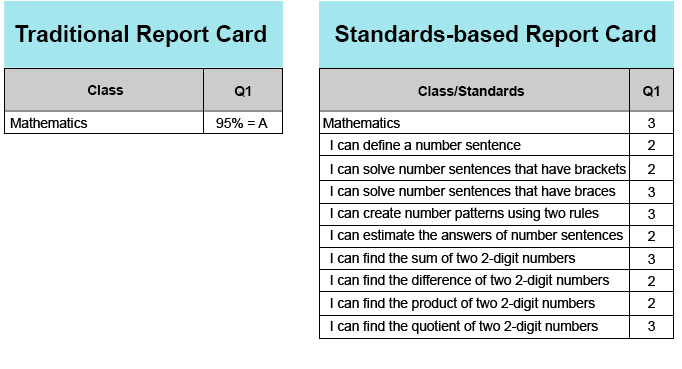
Supporting Students Every Step of the Way
At Weaver CDC, our goal is to nurture confident, compassionate learners. We want to understand not just what they’re learning, but why it matters. Standards-based grading ensures that each student’s progress is understood, celebrated, and supported.
By focusing on mastery and growth, our grading system reflects the true heart of Weaver CDC. We honor each child’s potential and create a joyful, purposeful learning experience.
If you’d like to learn more about how your child will be supported at Weaver CDC, schedule a tour today!